Turn it over: the back never lies
Everything a seller might exaggerate on the front is written plainly on the back. On a hand-knotted carpet you can see each knot as a small, slightly irregular bump, row after row, and the design reads almost as sharply as on the face. That sharpness is the direct result of every knot being tied by hand exactly where the pattern needs it.
A machine-made rug shows none of this. The back looks uniform and mechanical, the pattern appears blurred or ghosted, and often there is a coating, a mesh or visible lines of stitching that hold the pile in place. Ten seconds with a turned-over corner settles most questions before any conversation starts.
Read the fringe
On a genuine hand-knotted carpet the fringe is not decoration. It is the warp, the vertical skeleton threads of the carpet, continuing out of the body of the weave. Follow a fringe strand with your finger: it should disappear into the carpet itself.
On machine-made rugs the fringe is usually a separate strip sewn or glued to the end after production. A visible seam where fringe meets rug is one of the fastest and most reliable signs of machine work.
Look for the human hand
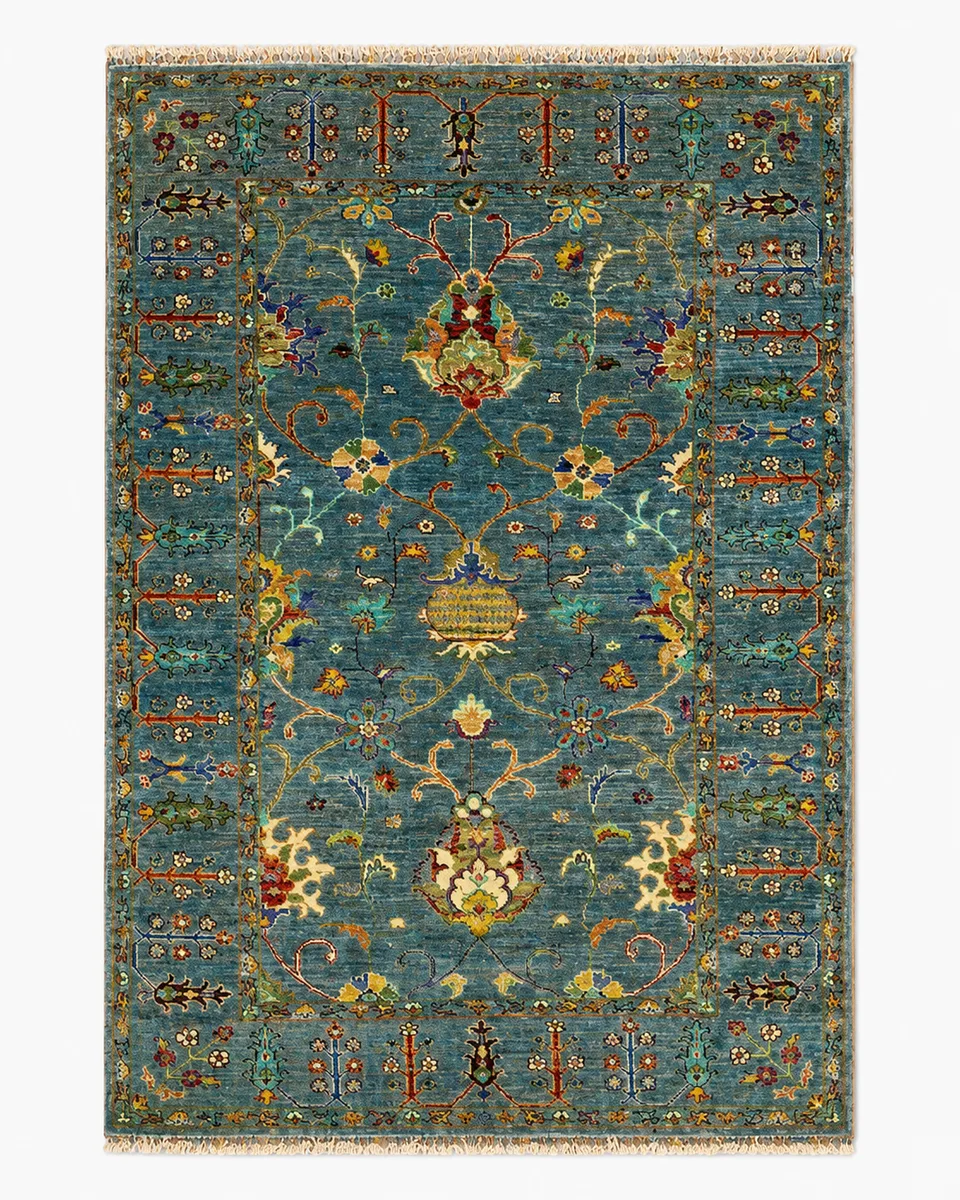
A carpet knotted over months carries the record of the weaver's decisions. A border that narrows slightly on one side, a motif that leans, a medallion a finger's width off centre: these are not defects. They are the difference between a woven object and a printed one.
Colour tells the same story. Vegetable-dyed wool and silk shift subtly where one dye lot ends and the next begins, producing soft horizontal bands known as abrash. Machine production, mixing synthetic dye in bulk, has no reason to show any of this. You can see abrash and hand-drawn irregularity across the handmade rugs in our Istanbul archive.
If it claims to be silk, make it prove it
Real silk changes with the light. Walk around the carpet, or brush the pile in two directions, and the colours should shift, sometimes dramatically, because each filament reflects light directionally. Artificial silk, usually mercerised cotton or viscose, has a flat, uniformly white sheen that stays the same from every angle.
Fineness is the other tell. True silk allows very high knot densities, which is why the most detailed carpets in the tradition, such as Hereke silk carpets, are silk on silk. If a piece is sold as silk but the knots on the back look coarse, the fibre and the price deserve more questions.
The five checks at a glance
| Check | Hand-knotted | Machine-made |
|---|---|---|
| Back | Individual knots visible, pattern nearly as sharp as the front | Uniform surface, blurred pattern, often mesh or coating |
| Fringe | Continuation of the warp, disappears into the weave | Sewn or glued on, visible seam at the join |
| Regularity | Slight asymmetries, motifs drawn by eye | Perfect mechanical repetition |
| Colour | Soft abrash bands, depth that varies with light | Flat, even colour throughout |
| Edges | Selvedges wrapped by hand, small variations | Machine-finished, perfectly straight |
When in doubt, buy where the question is welcome
None of these checks requires expertise, only permission, and the shops worth your time grant it gladly. Ask to see the back, ask what the fibre is, ask where the piece was woven. In our showroom a short walk from Hagia Sophia these are the questions we most enjoy answering, and the full collection is documented piece by piece for exactly this reason.