A workshop born for a court
Hereke is a coastal town on the Gulf of İzmit, east of Istanbul. In the nineteenth century, imperial workshops were established there to weave for the Ottoman court, and the palaces of Istanbul were furnished with their work. That origin still defines the tradition: Hereke weaving was never village craft scaled up, but palace standards maintained by workshops that answered to a throne.
The consequence is a distinct identity. Where much of Anatolian weaving is bold, geometric and personal, Hereke work is court art: dense, precise, floral and often pictorial, closer in spirit to miniature painting than to tribal weaving.
What the density actually means
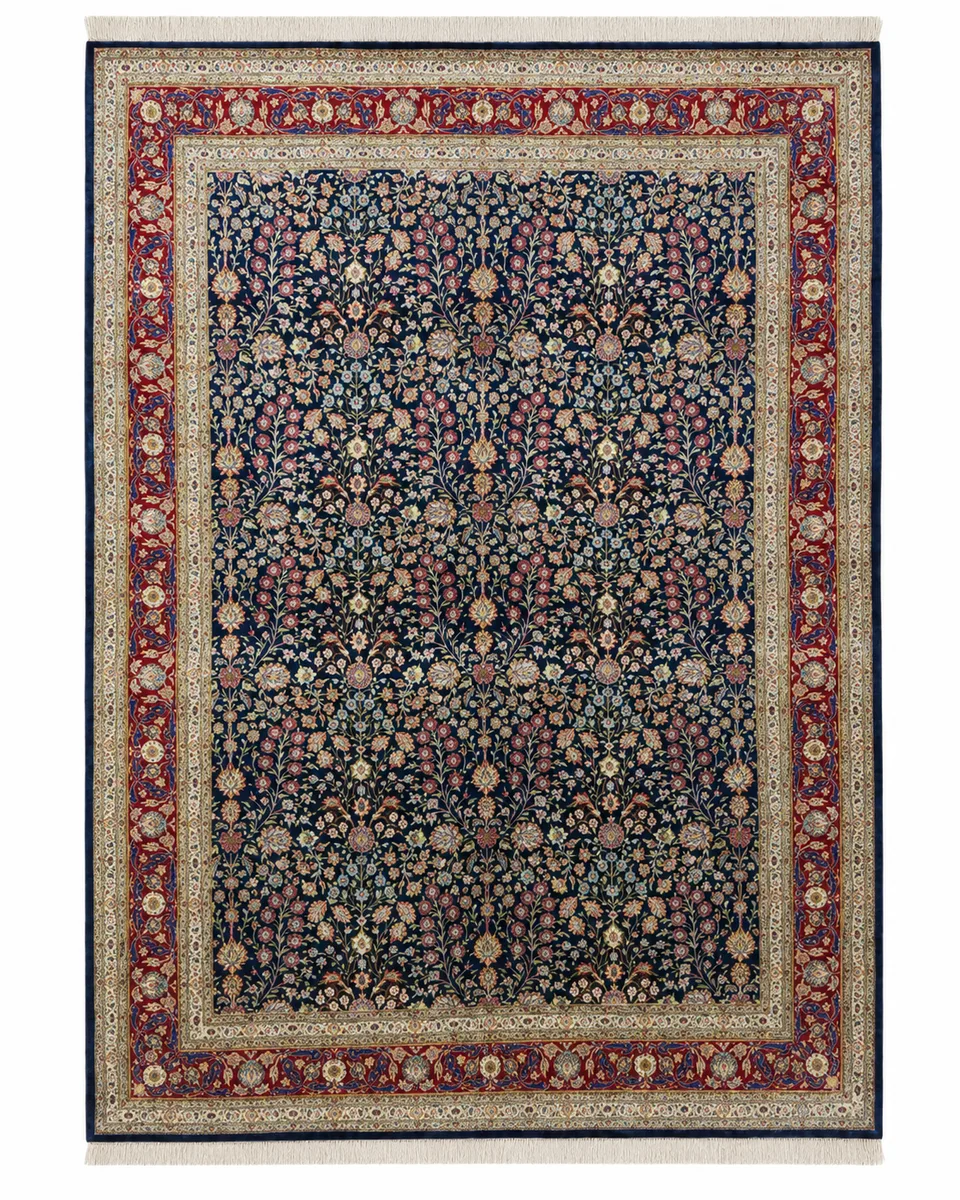
The defining fact of a fine silk Hereke is knot density. The piece in our archive holds at least 36 knots per square centimetre, and the tradition reaches higher still. Every one of those knots is tied by hand with the symmetric Gördes double knot, the sturdier of the two great knotting techniques.
Density is not a bragging number; it is resolution. Just as finer pixels allow a sharper image, finer knots allow curves that flow, faces and animals that read clearly, and borders whose detail survives being scaled down to a few millimetres. The pictorial Herekes, with their peacocks, stallions and garden scenes, are only possible because the knotting is fine enough to draw with.
The motif repertoire
Hereke inherited the Ottoman palace vocabulary: the tulip, the carnation and the cypress, worked into medallions, prayer niches and endless-garden fields. Alongside these run the figurative compositions the workshops became famous for, among them the tree of life, paradise garden scenes dense with birds and blossom, and equestrian and animal subjects treated with a miniaturist's patience.
Colour completes the signature. Vegetable and other natural dyes on silk give Herekes a depth that shifts with the light, from saturated navy and black grounds to turquoise, rose and ivory borders.
How to recognise a genuine Hereke
| Check | What a genuine piece shows |
|---|---|
| Knot density | Exceptionally fine, small knots on the back; in silk, tens of knots per square centimetre. |
| Material | The finest pieces are silk on silk: silk pile knotted onto silk warps and wefts. |
| Drawing precision | Curves flow without steps; figures and faces read clearly even at small scale. |
| Back of the carpet | The design is almost as legible on the reverse as on the face. |
| Signature | Often present and woven into the end of the field, but meaningful only when the weave itself agrees. |
The order of those rows is deliberate. Density and material first, signature last. A woven name can be copied in an afternoon; hundreds of thousands of fine silk knots cannot. Our guide to identifying handmade rugs covers the general checks that apply before any of the Hereke-specific ones.
Living with one
A silk Hereke asks only for common sense: a calm room or a wall, rotation once in a while, no constant direct sun, and professional cleaning when it is needed at all. In return it holds its colour and detail across generations. The Hereke pieces in our archive can be seen in person at our showroom on Divanyolu Street, a short walk from Hagia Sophia, and each is available by private inquiry.